
What Causes GNSS Signal Reception Problems?
Recently, GNSS users have reported signal reception issues, ranging from reduced positioning performance to complete signal loss in certain cases. These problems are primarily caused by increased solar activity and its effects on the Earth's ionosphere.
Solar activity follows an approximately 11-year cycle, known as the solar cycle, during which the intensity and frequency of solar flares and coronal mass ejections increase and decrease. During periods of heightened solar activity, known as solar maximum, disruptions to communication systems and GNSS services become more frequent and more severe.
Solar flares and geomagnetic disturbances are currently occurring at elevated levels and are expected to reach their peak during Solar Cycle 25, with maximum activity anticipated around 2025.
This phenomenon is global, although its intensity varies across different regions of the world. In some cases, disturbances may also be localized, causing RTK algorithms to struggle when measurements from the base station and rover are affected differently by ionospheric conditions.
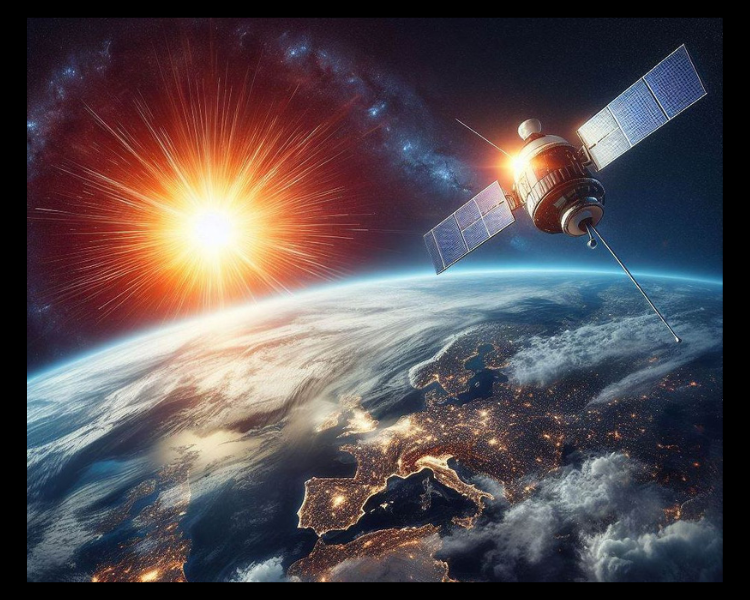
What Are Solar Flares?
| Solar flares are powerful bursts of radiation originating from the Sun's surface and atmosphere. These events release intense electromagnetic radiation across a broad spectrum of frequencies, ranging from radio waves to X-rays and gamma rays, and can trigger a variety of effects within the Earth's atmosphere. | 
|
How Do Solar Flares Affect GNSS Signals?
 |
The intense radiation produced by solar flares causes increased refraction and absorption of radio waves within the ionosphere, the region of the Earth's atmosphere that contains a high concentration of charged particles. These ionized layers affect the propagation path of GNSS signals, introducing delays and distortions that can significantly impact positioning accuracy. As ionospheric activity increases, the ionosphere becomes denser, causing GNSS signals to experience greater propagation delays, particularly on the frequencies commonly used by GNSS systems, such as L1 and L2. These effects can lead to reduced positioning accuracy, difficulties in achieving or maintaining RTK fixed solutions, and, in severe cases, temporary loss of GNSS signal reception. |