
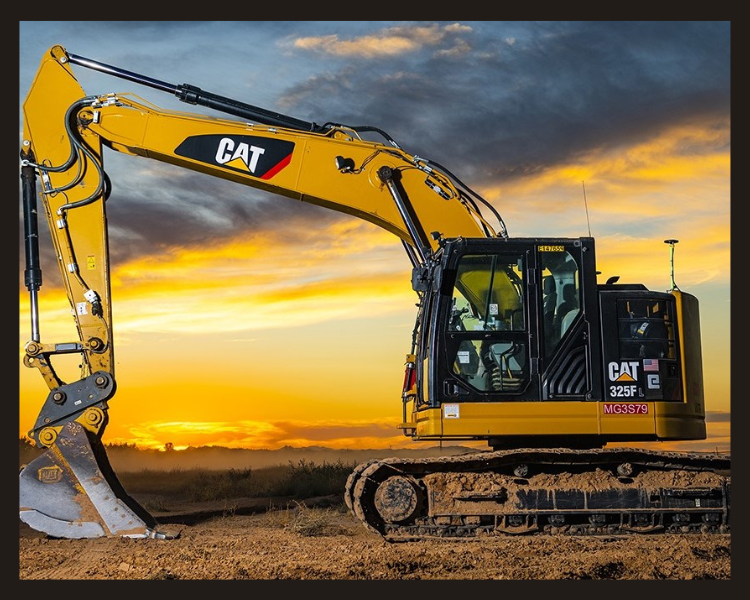
The software and hardware installed on a construction machine (excavator, loader, bulldozer, etc.) is referred to as a machine control system. It accurately determines the machine’s position and orientation while simultaneously guiding the machine—and its moving components—along predefined paths and toward target positions.
This enables operators to perform excavation, grading, and earthmoving tasks with greater precision, efficiency, and consistency, while reducing errors, rework, and project completion time.

A machine control system typically consists of:
-
A GNSS receiver that determines the machine’s position and orientation. The receiver usually utilizes two antennas to receive satellite signals. In addition, it receives correction data to achieve the level of positioning and heading accuracy required for construction applications. These corrections are typically received either through a VHF radio modem or via a SIM card. Correction data may be transmitted from a local base station installed at a known location near the construction site or from a network of permanent reference stations.
-
Horizontal and vertical motion sensors installed on the machine’s moving components. These sensors continuously determine the relative position of the machine’s attachments with respect to the main body of the machine.
-
An in-cab control unit (display) that is easily accessible to the operator. The project design data is loaded into the control unit, where all necessary calculations are performed. The system then provides real-time guidance, indicating how much the machine must move horizontally (left/right) and vertically (up/down) so that the point of interest—such as the bucket, blade, or other attachment—reaches the exact design position.

EQUIPMENT APPLICATIONS
Although the construction industry is one of the largest industries in the world, it remains one of the least automated. Smart technologies, such as 3D positioning and machine control systems, are key drivers of automation, helping increase productivity and deliver significant return on investment (ROI) for construction professionals.
Traditionally, when construction work began on a job site, a surveyor would stake out points to mark the three-dimensional position of the project. Construction machinery would then perform the work based on these reference points. However, these points were often damaged or, even worse, displaced due to accidental handling or the activities of other crews working in the same area.
While this method has been successfully used for decades and remains in use today, technology has evolved to make project execution simpler, safer, and more efficient.
Today, construction equipment can be fitted with machine control systems and perform tasks without relying on physical stakeout points to determine its position. This significantly improves accuracy, productivity, and overall operational efficiency.
CHALLENGES
The adoption of machine control technology remains relatively low. The high initial investment cost is one of the main barriers to implementation.
A second factor affecting adoption is that the equipment installed depends on the specific type of construction machine. Different machine configurations and additional functionalities may increase system costs. However, the productivity gains and return on investment typically justify the expense in most applications.
Another challenge is the training and expertise required for proper system operation. Although machine control systems and associated workflows are becoming increasingly user-friendly, these solutions still require proper setup and configuration before they can be effectively used in the field.
Prerequisites such as data preparation, sensor calibration, local coordinate systems, and RTK correction services are essential to ensure maximum performance and efficiency.
An additional factor limiting wider adoption is the lack of standardized specifications for project implementation using machine control technologies.
BENEFITS
Easier Project Coordination and Management
Machine operators have access to accurate, real-time information regarding both their current working position and the final design they are required to achieve. This improves coordination, decision-making, and overall project management.
Increased Accuracy
The precision provided by machine control systems minimizes the need to interrupt work for survey crews to stake out horizontal and vertical control points. It also eliminates the need to re-establish these points if they are damaged by equipment operators or other personnel working on site.
Furthermore, machine control systems enable projects to be completed accurately the first time, reducing rework, machine operating costs, labor hours, and fuel consumption.
Maximized Efficiency
Precise machine guidance significantly accelerates project execution. Since machine positioning and navigation are continuously available, operators do not rely solely on direct visual references, allowing work to continue efficiently even under low-visibility conditions or during nighttime operations.
The system helps operators achieve the desired result in the shortest possible time while maintaining high levels of accuracy.
Cost Savings
Overhead and operating costs are reduced, as operators can achieve the required quality faster while consuming fewer resources and less fuel. In addition, the ability to perform tasks directly from the machine cab creates a safer working environment and significantly increases productivity.
Data Management
Machine control systems provide the ability to document project execution without requiring additional measurements from external contractors. They support as-built data collection, enabling the creation of reports, documentation, and comprehensive records of completed work.
 |
 |
GEOTECH's partnership with Hemisphere GNSS is driven by a commitment to providing customers with advanced technologies that enhance efficiency, flexibility, and productivity in construction operations.
GradeMetrix is Hemisphere GNSS’s comprehensive machine control solution, delivering high-accuracy guidance through advanced GNSS positioning technology. The GradeMetrix product portfolio includes solutions for earthmoving applications using bulldozers and excavators.
Whether for grading, mining, excavation, or compaction applications, GradeMetrix solutions provide superior performance, increased operational efficiency, and exceptional value, helping contractors complete projects faster, more accurately, and with greater confidence.