
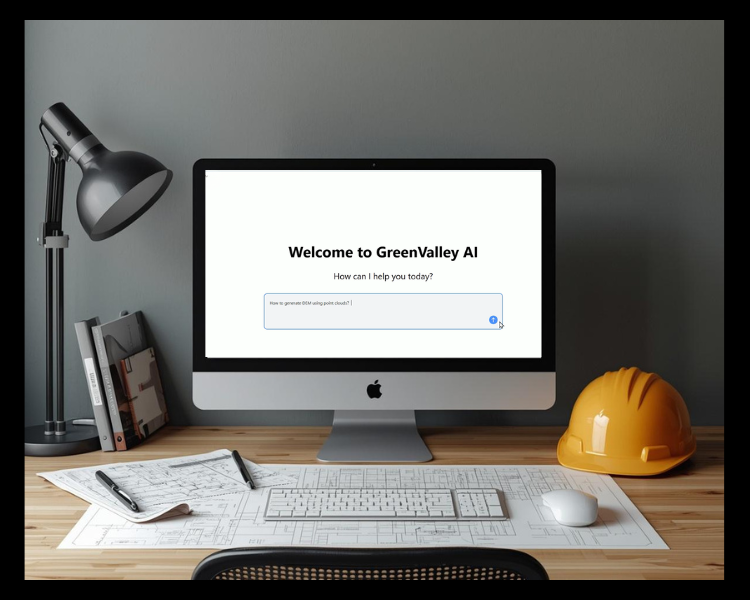
Large Language Models (LLMs) are artificial intelligence models trained on vast amounts of text, capable of understanding and generating natural language. In practice, they function as an intermediate layer between the user and the software, transforming instructions such as “clean this point cloud and generate floor plans” into suggested actions, workflows, or even executable processing steps.
Until recently, anyone working with surveying data and reality capture projects knew one thing: to achieve results, you had to learn the software.
Particularly in specialized applications, the process was—and continues to become increasingly—complex. Dozens of steps, extensive menus, and numerous parameters had to be configured correctly.
Today, that is beginning to change.
With the emergence of LLMs, software interaction is shifting from “How do I do it?” to “What do I want to achieve?”
From Process to Outcome
Traditionally, point cloud processing from 3D laser scanners involved:
-
Noise removal
-
Data registration and georeferencing
-
Mesh or surface generation (depending on the final deliverable)
-
Production of final outputs such as elevations, floor plans, and orthophotos
With LLMs, the starting point changes.
You no longer begin with the tool.
You begin with the desired outcome.
And you simply describe it:
“I want a clean point cloud and, from it, generate floor plans and elevations.”
But the Data Is Massive
Data collected from SLAM systems and laser scanners is not just large.
It is extremely dense, often noisy, and may contain orientation errors or drift.
Until recently, this meant:
-
Manual cleaning
-
Multiple filtering stages
-
Repeated trial-and-error workflows
Today, you can start differently:
“Clean this point cloud, remove outliers, and prepare it for orthophoto production.”
The result is not generated automatically without verification. However, the workflow can be organized and accelerated significantly.
The Role of the Professional Is Changing
LLMs are not a magic solution.
The professional is not being replaced.
The role is evolving.
Instead of executing every step manually, the professional becomes:
-
The person who defines the problem
-
The person who validates the result
-
The person who guides the process
There is less need to memorize every tool and command. What matters is understanding what needs to be achieved and how to evaluate the outcome.
Conclusion
LLMs do not make point cloud processing simple.
They make it more accessible.
Instead of focusing on how to execute every individual step, professionals can focus on what they want to produce.
Ultimately, the most valuable skill is no longer knowing every tool available.
It is being able to clearly describe the desired outcome—and recognize whether the result is truly correct.